Wednesday, April 19, 2006

Buttology

First Scatology, now Buttology.
What's next? Penisology? Hmm......

Rear Admirable
David Holmes, a psychologist at Manchester Metropolitan University, insists that a good bum is key to attractiveness, and he's devised a formula that describes the ideal female buttocks. According to Holmes, maximizing (S + C) x (B + F)/T - V makes for gluteal greatness. S is overall shape of the bottom, C is circularity (how spherical the butt is), B is resilience to bouncing and wobbling, F is touch firmness, T is skin texture and V is the vertical ratio or "pertness." Holmes added that a hip to waist ratio—waist size divided by hip size—of 0.7 is ideal for framing a woman's posterior.

Holmes found the formula by getting 2,000 British women to rate their own bottoms. In the shape category, those with a "trodden doughnut" got only one point, whereas those with a "small peach" scored the maximum five points. After compiling all the factors, a total of 80 points was labeled "perfection," whereas booties earning fewer than zero points were told to "stay indoors." But don't fear, saggy bottom girls, Holmes writes, "Failing all else, confidence and good conversation can sometimes distract attention, if not compensate for a 'bum deal' in the buttock lottery."

"Borrowed" from online Seed Magazine, New and Notable

The Honesty Meme

I came across a passage in Zen and the Art of Motorcycle Maintenance by Robert Pirsig that was an echo from my own past.

A brief converstaion between Pirsig's son, Chris, and he:
"Dad?"

"What?"

"What should I be when I grow up?"

I don't know what to say. "Honest," I finally say.

I recall asking my father the same question. I clearly remember his response:
"Whatever you want to do, whatever you want to be. But always be honest to yourself and to others."

I've tried hard to do just that, Dad. I've changed my mind a few times, but at least I'm honest about that.

If my daughter reads this, I want to tell her the same: always be honest with yourself and with others. And follow the path that has heart.

Tuesday, April 18, 2006

"Paranoia strikes deep.......

.....into your heart it will creep. Starts when you're always afraid. Step out of line, the Man comes and takes you away."

A flashback from the '60's. Yet history has a nasty habit of repeating itself.

The event of 911 evoked a rekindling of community, cooperation, altruism and cohesiveness amongst not only a city but a nation. It even expanded globally.

For a short time.

Then we 'reacted'. Since then, our country has degenerated into a nation of paranoia and fear in the guise of 'patriotism' and 'right'. Without an honest definition of each. In essence, the terrorists were successful. Look around you; read the papers, watch television, watch and talk to people. We are all afraid of ghosts. Mostly our own.

I mourn what we have lost, what we have become and what we could be.

The following is a small example that trickles down like acid rain on marble:
As a researcher in the medical field, disposable sterile scalpels are used in our labs for grossing tissues. I called to order a box of disposable scalpels from one of the largest scientific vendors in the country that has supplied most of the medical research and hospital labs here for years. Their reputation is impeccable.

I was informed that they were suddenly prohibited from shipping disposable scalpels by the federal government. They were waiting for 'approval' and I was encouraged to call back in 7-10 days. Two weeks later when I called to place the order, I was informed that the responsible federal bureau still had not released an 'approval' to ship disposable scalpels. With detectable frustration and apologies, they could offer no prediction of when that approval would be forthcoming.

I called another vendor that sells and ships medical supplies and was greeted with the same scenario.

We have become a nation of fear. We are afraid of ourselves.
We see ghosts and they don't even know they are ghosts.

Mad Scientists and Coffee

Early (very early) morning coffee with a few colleagues in the departmental office can be enlightening. We pondered several hypotheses of the origins and transmission of prion diseases (also known as transmissible spongiform encephalopathies (TSEs) for you pathologists) and how we can use that to control the deer overpopulation. We hypothesized that if deer cannibalize themselves a form of deer 'kuru' and chronic wasting disease (also associated with prions) would restore a population balance.

Tangenting into predictions of what life form will exist the longest on this planet, I posited that microbes will sit in their little habitats giggling at the extinction of the Big Two-appendaged Macrobes. Face it: humans are built 'wrong'. We don't excel at anything, but we are good, albeit slow, adaptionists. Regardless, we can't mutate fast enough to our own self-induced evolving habitat. Nor do we seem capable of seeing that we are destroying everything that gives us life on this planet. Perhaps our species will succumb to the same basic premise of habitat overpopulation dynamics and we will eat each other and die from kuru like the deer (anyone remember the movie Soylent Green?)

Contemplating the ultimate cure for all pathogenic illnesses, we narrowed it down to mucus membranes. Most pathogens gain passive entry into our body via our mucus membranes: our gut, mouth and nose. It provides moisture, nutrients, and an ideal cradle to multiply. Thus, we posited, if we don't eat, drink or breathe, we won't have to worry about getting sick! It is logical.

However, like good scientists, we need to test the hypothesis. We need more data. Our methodology is simple and falls within a NIH budget: duct tape. Now getting it beyond the ethics committee may be a problem.

Ah, the challenges of being a scientist......

Saturday, April 15, 2006

My Zen of Motorcycle Riding

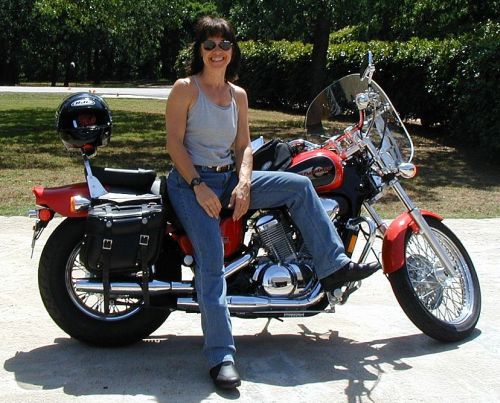
I have a motorcycle. I like to ride it. It takes me places in a way nothing else can, except for my horse. But my horse is getting old (like me), we can’t ride on public roads and he can’t travel as fast as a motorcycle. Similar to riding a horse, riding a bike is all about the journey; the destination is only one part of the whole. I often find that once I’m ‘there’, I want to get back on again and go.

Horses have names, so does my bike: Red (Red Sonja). Just as every horse has the same basic anatomy, and motorcycles share similar mechanical concepts (power system, function, etc), they all express an individual personality. Red and I are becoming well acquainted; I learn something new about it and myself every time I ride. We both have personalities and I am still learning to mesh mine with Red’s. Every time I add or change something on Red, we go through another meshing.

After the first few times I rode Red, I realized this is not just a machine. Well, rationally, it is a machine, in that it has moving parts, burns combustible fuel and expels waste; it gets hot and cold, and something occasionally breaks that needs repair or replacing. But to really ‘know’ my bike, to truly become ‘one’ together, I have to learn how all the parts of the bike work in synchrony just like my own body. I realized at some point in time I would need to learn how to maintain and fix things myself. Moreso, I want to fix things myself. I have to learn how, what and why. Like knowing anything else, it’s a process.

I posed a question to an online motorcycle group on which I participate and it generated slight confusion. I received answers that created more questions, and even more answers. But that’s the process of learning about anything. Rather than knowing only the effect, I want to learn the cause(s) as well. Invariably, peeling away one component reveals another, and on and on until a system is pieced together. In reality, there is usually more than just one answer, more than one way to go from point A to B.

Now, I approach this endeavor the same way I do working with biological questions. Identify the components and their functions. Examine all the small parts at the molecular level. Sort them according to function and location, and ask how they interact with each other, either top down or bottom up. Then ask how that system and its components, interact with other components outside that system. This is the “system” comprised of sub-systems. How they all work together is like a symphony. When all the instruments are tuned and their sounds mesh, you hear and feel beautiful music: it’s ‘right’.

My question to the group was: how does wind affect gas mileage? Realizing that it was a complex question and there would be several answers, sure enough many factors affect gas mileage. The style in which one rides, the intrinsic components of the bike (engine, transmission, power, fairings, etc), and environmental elements. I targeted one element: how does altitude affect engine performance? Of course, what I was asking was a physics-based question (ultimately everything is reduced to physics). So I learned about air density, humidity, temperature, fuel ratios and altitude.

Regardless, all of these factors influence gas mileage: Wind, altitude, gas octane, engine components, bike design, road surface, temperature, style of driving (e.g. commuting versus long-distance open road). And experience. I explained to my fellow riders that as a novice and a scientist, I want, no, need to know the concepts, the fundamental theories of parts, how they work alone and in synchrony, and why. Then I can add my empirical data, experience on the bike under different conditions, to the basic fundamental knowledge and concepts, and ultimately I am able to alter the behaviour of the bike and my riding.

Being aware of all of these components when you ride allows you to feel all of it in synchrony: the wind, temperature, altitude, fuel combustion, speed, road surface, and so much more. But rather than be overwhelming, it all becomes a part of you and your bike together. Does it detract from the beauty and enjoyment of riding a bike? Only if you let it. On the contrary, it can enhance the sensation and pleasure of riding. Your bike becomes more a part of you and you a part of your bike.

It is my ‘zen’ of riding.

Thursday, April 13, 2006

Walkabout

The truth knocks on the door and you say, “Go away, I’m looking for the truth,” and so it goes away. Puzzling. – Robert Pirsig*

Time for a Walkabout

Every so often we need a change. We become so caught up in our own small box of existence, hurrying most of our time away, losing grasp of what is important to each and all of us. We repeat the same day-to-day routine, a monotony that becomes shallow yet comfortable for most. It’s as if we become robots on automatic pilot. Then at some point in our lives we wonder where all that time went and sorry that it is all gone. We can’t go back to regain it.

Familiarity is comfort to most; it is ‘safe’, reassuring and relatively risk-free. We tend to shy away from risk and strangeness. Yet the world is full of wonderful strangeness. And what makes this world so hard to see is its usualness. Familiarity can blind you, too.

We accumulate new information and experiences every day, sometimes it is overwhelming. Our perspective tends to become more narrow and smaller housed inside our little box of comfort. We become the center of the cosmos and familiarity shrink wraps us inside the nucleus of our own ego. Our ‘I’ is a small parasitic microbe that only moves to provide for our immediate physiological and psychological needs. In time we become bored with our own little box and find ways to fill the empty spaces as we implode inside ourselves. We become disconnected with others and our environment until the robot is nudged out of autopilot. And malfunctions. We become dehumanized.

Robert Pirsig wrote*:

You see things vacationing on a motorcycle in a way that is completely different from any other. In a car you're always in a compartment, and because you're used to it you don't realize that through that car window everything you see is just more TV. You're a passive observer and it is all moving by you boringly in a frame…… On a cycle the frame is gone. You are completely in contact with it all. You are ‘in’ the scene, not just watching it anymore, and the sense of presence is overwhelming.

Metaphorically our lives become like the compartment of a car: the passive observer, too busy to talk to each other, passing life by outside without really touching it, experiencing it. By the time we stop to look back and wonder where it went, it’s too late. This is a dead end.

The Australian adolescent aborigines (and many other indigenous peoples) go walkabout for weeks or months as a rite of passage. I often refer to go walkabout when I travel without a planned itinerary or even destination. It is all about the journey, not the destination.

When the spirit falters, when we find ourselves questioning, confused, or need to break the cycle of familiarity, go on a walkabout. At times I use a walkabout to break the distractions of my ‘box’ of life, or when life throws me a curve ball that hits me square in the heart. Sometimes the surroundings of silence and space allow me to hold and direct the construction of my thoughts. Other times it is the strangeness of the environment and the people that break down the walls of my box and allow me to expand outside again, refreshing my perspective.

Invariably, walkabouts give me the clearness and fortitude to open the door when Truth comes knocking.

* Zen and the Art of Motorcycle Maintenance. By Robert Pirsig.

Thursday, April 06, 2006

Mounting Evidence for the Noodly Appendage of Flying Spaghetti Monster

Debate continues on the validity of God, Flying Spaghetti Monster, Intelligent Design, and non-belief.

Evidence for the existence of Flying Spaghetti Monster, or beings created in his image, were discovered last year. Long noodles were found under ten feet of sediment during an archeological dig in NW China. The noodles are believed to be 4,000 years old.

Are these ancient noodles the ancestors of our modern noodles? The biological composition of the 4,000-year-old noodles suggests that modern noodles evolved over time and perhaps China was the epicenter of their origin. Was the creation of these noodles spontaneous or do they also have a predecessor? Perhaps they were created in the image of the divine Noodly Appendage or serve as an example of spontaneous creation.

Additional evidence is needed to prove that the noodles found at Lajia are the ancestor of either Asian noodles or Italian pasta. "But in any case, the latter is only documented two millennia later," Lu said.

Combined with this discovery, additional research presents empirical evidence in support of Flying Spaghetti Monsterism. Researchers report spontaneous generation of a new species of pasta: Noodleus doubleaous. In lieu of an acceptable explanation, the authors conclude that observed results were guided by the hand of an intelligent designer.

Doubters may refer to their popular Belief-o-matic for consultation on their Belief du Jour in this matter.

Tuesday, April 04, 2006

Miss Information

If we reduce life, and nearly everything in existence, to the most common denominator, what do we have?
Information.

DNA information is transmitted through RNA, transferred to ..........proteins......cell signaling.....adaptation..... on and on. Read a paper, watch TV, bombardment by your fellow Infomation Perpetuators; we are all information carriers and transmitters. Some should be eliminated from the Information Pool.

There are many genres and species of Information. Even genders.

In today's world of modern technology and its ability to rapidly propagate, we have a skewed gender population of Infomation: Miss Information.

When Miss Information rolls down hill, she balloons, sprays everywhere and the repercussions extend exponentially.

Here is a critique of Miss Information dressed innocently as 'education.'

"How stuff doesn't work"

Pharyngula, the mind of PZ Myers.

Saturday, April 01, 2006

April's Fool Day

I woke up this morning with a warm naked body next.....

Oh wait, that was a dream.

Got out of bed greeted by humid warm air blowing through all the window curtains, chirping birds outside the windows, the smell of moist Texas air. The sun hiding above the laden fog and clouds with a hint of later sunshine and heat. Wear a tank top under the jacket today; it's going to be a humid toaster.

The smell of freshly made coffee mixes with the moist breeze in the house and I see my horse outside grazing, stark black against the blended green and brown terrain. The barn roof drips condensation which the ground absorbs quickly. The cows next door meander contentedly.

After throwing water on my face and donning top and pants, I gather a change of clothes, shampoo and toothpaste, top my thermal mug with coffee, and pack the laptop accessories into the padded backpack. We've got miles and miles and days away ahead of us.

Grab the keys on the way out the door and greet the silver FJR waiting outside under cover like a trusty steed waiting for its master. Checking it over, stuffing the hardbags, and strapping the backpack onto the back rack, my leg swings over to straddle the seat. Sitting down in that comfortable sheepkin-cushioned saddle, shift into neutral, turn the key and push the start button. The sound that makes you go hummmmm.....

Sit for a while enjoying the peace and quiet while the Silverado between my legs warms to a purring idle. Smiling, the jacket is zipped up, the helmet is on and strapped, gloves envelope my hands and we ready to roll. Right the bike, push up the kickstand, shift down and roll the throttle. We're off.

Taking the country road curves slowly this morning, making our way to the highway heading south. Got a long day with ribbons of road ahead. No need to push it until the urge arises to crank the throttle open for a gazelle-like sprint. No cars in sight, no lights, no horns. Only the open road ahead and behind, going somewhere through space and time. Right now, there's only me and my steed. And right now, that's all that I need.

April Fool's Day and wishful thinking.

For those who can, have a good safe ride today.

Wednesday, March 29, 2006

Wasabi Receptors Unite!

Woohoo!!!!! A ‘wasabi’ receptor!!!

Harking back to a discussion with a colleague from India, we debated the merits and preferences for tasting ‘heat’. By that I mean hot peppers and wasabi. Our preferences were the converse: he preferred peppers and I, wasabi. We also agreed on a similar tendency in that while exhibiting a high tolerance for our preferred ‘heat’ generator, we had a relative high pain sensitivity and intolerance for the other.

We debated that perhaps tolerance may be a function of conditioning: his typical diet incorporated foods prepared with copious amounts of ‘high octane’ peppers. Whereas I tend to prefer Asian foods that are traditionally accompanied by wasabi, or even smearing wasabi on other foods such as ham or even eggs. However, living in Texas, I also eat a fair amount of the typical Southwestern fare often doused with hot peppers. Regardless, I haven’t been able to overreach food with a rating of one by the Scoville chile heat index (100-1,000 Scovlille Units), except for an occasional exploration of a meal that may rate a two if accompanied by plenty of neutralizing chips and iced tea.

The magic ingredient of chili peppers that endows that heated kick is capsaicin, a oily substance found in the veins of a wide variety of peppers. Capsaicin delivers a burning and painful sensation in the mouth and on the skin due to its interaction with sensory neurons. The chemical binds to receptors, classified as TRPV1, that are also stimulated by heat and physical abrasion. When stimulated, these receptors permit ions to pass through the cell membrane and the neuron ultimately signals the brain. The result is the sensation of burning.

Typical of the negative feedback control by most receptors, chronic exposure to capsaicin depletes the neuron of neurotransmitters, leading to a reduction in pain sensation and neurogenic inflammation (a process called ‘desensitization’). After capsaicin is removed and following a short refractory time the neurons recover. This may explain why people who traditionally eat food containing hot peppers have a higher degree of tolerance.

Nevertheless, this does not explain why the differential tolerance, and intolerance, of chili peppers and wasabi. The pain-associated chemicals in wasabi, a Japanese horseradish, are similar to those found in hot mustards: isothiocyanates. The wonderful sinus clearing vapors of wasabi are the primary contrast to the heat of hot chili peppers. Yet both produce painful sensations in the mouth and on the skin when topically applied, exciting sensory nerve fibers.

Whereas hot chili peppers titillated my colleague, I covet the rush through the sinuses and tearing aftermath of wasabi. Both of us exhibited a greater degree of sensitivity (and dislike) for the other source of painful sensation. Could the sensations and tolerance be more than just dietary conditioning? I ventured to posit that perhaps there is a receptor for wasabi!

A recent study in Cell now reports that different receptors are involved in the pain sensations of capsaicin and mustard thiocyanates. While both receptors affect neurons on the pain pathway, TRPV1 receptors are associated with capsaicin and TRPA1 receptors with other plant chemicals specifically found in garlic and various mustards. This implies that they segregate at the molecular level yet elicit similar physiological overlapping responses (irritation and inflammation).

Belonging to a group of neuron receptors in our skin, and on our mouth and tongue, they are part of our natural defense system. Transient receptor potential (TRP) ion channels are like molecular thermometers that detect temperature, mechanical abrasion and irritating chemicals. They help us sense temperature and irritants through the skin and, as we can attest, in spicy and hot foods. Even volatile odors, as evidenced by eating wasabi and the mucus membranes in the sinus cavity and lungs. Ultimately, a message is sent to the brain: “Danger, Danger!” In fact these irritant chemicals are a component of the plant’s natural defense system.

On the other hand, both capsaicin and mustards are used in alternative medicine as topical ointments to relieve pain. Applications to the skin are left on until the area is numb. This is induced by overwhelming the local neurons and depleting their neurotransmitters that create the painful sensation and blocking neurogenic inflammation. Another medicinal use that I discovered serendipitously is to clear the sinuses of mucus from upper respiratory infections.

Alternatively, I just plain enjoy the rush of that volatile wasabi up through my nose and sinuses. You can keep the capsaicin, though.

So, yes, Dr. Sri; there really is a ‘wasabi’ receptor after all.

Cell, 124: 1269-1282, March 2006. TRPA1 mediates the inflammatory actions of environmental irritants and proalgesic agents. Bautista D, Jordt S, Nikai T, et al.

Dear Dairy (No. 3)

This has to be one of the most brilliantly created advertisements I have ever encountered:

Brittleactica
http://www.planetinneed.com/

And if there is any question regarding the sleep-inducing power of milk? It is highly efficacious.
(tryptophan + carbohydrates = serotonin -----> zzzzzzzzzzzzzzz......... sleeeeep)
I've also noticed an effect on dreams (or dream recall, perhaps both)

Herocka!!

Friday, March 24, 2006

Friday

Solid phase water encased my windshield this morning,
What planetary constant allows this absence of heat?
Driving into the sunrise admiring hues of blues, violets, and reds
Resisting the urge to vaporize the car in front hogging the passing lane.
Adhesions ripping apart while stretching
my recovering left foot.
Vision rudely disturbed by a large white splat deposited by a flying bird.
My head is drawn away from fragments of last night’s dreams
By the uplifting taunting whine of an electric guitar on my stereo.
Notes take me higher lifting me out of the morning haze
As I ponder finding a windshield that belongs on my bike.
Looking forward to the next morn, after donning warm gear,
Throwing my leg over humming metal, sitting deep in the saddle,
Feeling that infusion of adrenaline, balance it with zen,
Pull face shield, shift down, roll the throttle, and lift off.

The sun is shining and it is Friday.

This is good.

Sunday, March 19, 2006

Time Machine: Journey One

During a visit to the National Museum of Natural History and Science (New York, NY) years ago, I was awestruck by the display of creatures that roamed this planet before we were ever a gleam in evolution’s eye. Always captivated by the giants who preceded us, I commented to my companion during that visit that if we had time travel I would be one of the first to volunteer to go back and be an ‘Observer’. When prodded what I would like to see or do if I had one chance to go back in time, I couldn’t respond (perhaps for the first time). Too many events flooded my mind.
During the three years ensuing that visit, I have pondered that question again and often: What would I do, where and when would I go, and what event in time do I want to see? This is a series of responses to that question. Sorry, Mark; life is not that simple to provide one answer.

Skunks
Spring is here in Texas; it is the time of flowing pheromones and nature’s drive to reproduce where ever it can. Two and four-footed creatures are on the move to seek a mate, or just mate. As I drive down country roads I see and smell that little black and white furry bugger that isn’t so cute: skunk. Occasionally I wake to the malodour of Pepe Le’ Pew, such as this morning. Having been a victim at close range many years ago, suffering a direct hit, I still have an associated cringe and and clenching of the stomach, along with an almost reflexive attempt to block the smell and taste of skunk perfume.
This morning I was awoken by a strong skunk presence, enough to incite me to jump out of bed and clang the bedroom windows shut. Glancing out one window, I saw my arch enemy returning my gaze below with what could be interpreted as a “Heheee…gotcha” expression.
During my drive to town with a slight scent of skunk lingering on my clothes, I contemplated going back in time to find the ancestor with the culprit scent gland before it mated with the scentless ancestor of our modern skunk and removing it from the evolutionary chain.
The skunk family Mephitidae (derived from Mephitis, Latin for "bad odor") comprises of 11 species in four genera. Nearly all carnivores have scent glands, but they are especially enlarged in skunks and relative families, with skunks taking that enlargement to an extreme. Rather than a duct like it’s close ‘cousins’, the skunk scent glands at the base of the tail has a nipple. The glands contain approximately 15 cc of a yellowish, oily liquid. With highly coordinated muscle control, the skunk can aim and direct the spray as far as 15 feet and spay up to six times in succession. The only relief is that it takes up to 10 days to replenish the supply of liquid after full discharge.
The odoriferous liquid contains various thiols (sulfur compounds) and thioacetates (salts of sulfur compounds). The principle compound in skunk musk is butyl mercaptan, similar to the popular laboratory compound mercaptoethanol used to cleave disulfide bonds in organic solutions (to this day I cannot go into a lab without cringing at the smell of mercaptoethanol). Being sprayed in a direct hit can cause temporary blindness, nausea, convulsions, loss of consciousness and burns of the skin.
To neutralize skunk odor, the thiols have to be changed into compounds that have little or no odor. This can be done by oxidizing the thiols to sulfonic acids. Common oxidizing agents are hydrogen peroxide and baking soda (sodium bicarbonate) and are mild enough to be used on pets and yourself although it may change hair color. For clothes and inanimate objects sodium hypochlorite solutions (liquid laundry bleach) works well.
Skunk Evolution
Scent glands are ubiquitous throughout the class of mammals and serve as a form of olfactory communication. Distinctive and long-lasting smells are distributed in urine, sweat, or released by rubbing. These scents are deposited on the ground, on territorial boundaries, on offspring or mates, or their habitats. Yet the skunk has evolved to use their scent glands as a defensive weapon. Tail up, point, aim and shoot. Anyone taking a direct hit can attest to burning eyes, gagging, inability to breathe and rubbing any exposed skin to rid thyself of the noxious semi-viscous fluid and its aerosols.
What ancestor provided this adaptive trait? The oldest fossil identified as a skunk was discovered in Germany and dates to 11–12 million years ago. However, genetic data indicate the family originated about 30–40 million years ago. Research traces the evolution of the skunk from some of the earliest ancestors of modern carnivores and as members of the superfamily containing those of otters, badgers, and weasels, raccoons, and red panda. It is suggested that the origin of the skunk lineage occurred in the Oligocene approximately 40 million years ago (about 30 million years before the appearance of the first recognized fossil).
At some point in time, a weasely mammal sauntered up to a close relative and whispered in its ear “Hey baby, I have a secret weapon. Want to see it work?” Thus the lineage of the cute little furry buggers avoided becoming someone’s dinner. And they multiplied, with the semi-viscous stench dictating survival and adaptation.
I wonder if they had scent gland firing ranges for practice.

Tuesday, March 14, 2006

Dear Dairy (No. 2)

A recent quote by Jose' Mourinho, manager of Chelsea Football Club, when explaining why the team's soccer pitch in London is 'not as bad as it looks':

"Sometimes you see beautiful people with no brains. Sometimes you have ugly people who are intelligent, like scientists."

I am a scientist. Ergo, I am ugly. But I am intelligent and have a brain. Oh, woe is me.

However, my contribution to the reproductive success of intelligence genes has been, shall we say, limited by a matter of choice. Mine. Yet when I flip through the television channels and see the plethora of beautiful bodies with empty craniums, I feel guilt over my contribution to the 'reverse evolution' of our species. My selfish lack of interest in 'Bringing Up Baby' won over my patriotic duty to propagation of average appearance coupled with an intelligence factor that probably equals that of several TV starletts combined. That puts me at least with a positive quotient.

Can I still be sexy even if I have a brain? I don't need anyone's approval for that.
My pitch isn't bad either.

Thursday, February 23, 2006

Fun with Brains

Brainzzzz……

I want to change my field and be a brain researcher.

They get to do all the cool stuff. Like sticking the heads of five people into a machine (functional magnetic resonance, fMRI ) that scans their brains while they watch twenty commercials aired during the Super Bowl. The researchers’ intents were to gauge what type of a reaction they had, and the anatomical areas of the brain that were affected.

Commercials produced variable responses and in different areas of the brain. The so called ‘reward-centers’ (ventral striatum and the orbitofrontal cortex) in the brain showed activity during some ads. In response to other ads, the visual and auditory regions, or areas that contain “mirror neurons” were responsive. The latter are neurons that fire in an animal’s brain when it performs a task and also when the animal observes the same action performed by another animal like itself. They ‘mirror’ the other animal’s behavior and thus this activity is indicative of empathy.

Their qualification of a ‘good’ ad or a ‘bad’ ad was less objective and questionably interpretive. A ‘bad’ ad was interpreted by activity only in the visual and auditory areas, usually short-lived. On the other hand, ‘good’ ads were interpreted by responses of longer duration in the brain’s reward and empathy centers. However, I question the qualification of their terms ‘good’ or ‘bad’.

The complete analysis shows that the best ads are the Disney/NFL ad and the Sierra Mist ad,” Marco Lacoboni says, referring to the theme-park and soft-drink commercials. “In the Disney ad, NFL players ecstatically repeat ‘I am going to Disney’. I can see how this ad can elicit strong empathic responses.1

The scientists considered the Disney commercial a ‘good’ ad. Now I challenge you to find a handful of fathers in a sample pool of 100 that with sincerity and honesty admit they look forward to and love going to Disney, spending a month’s salary in a few days, fielding hundreds of screaming kids, and maneuvering the traffic and crowds. Perhaps the reward-centers and empathy were confused with internally muffled terror and anxiety of memories and anticipation of repeat visits. Is that really a ‘good’ ad, Docs?

Another commercial depicted a woman playing football with other women but that also somehow advertised beer. The fMRI revealed that the mirror neurons fired in the brain of a female subject, indicating empathy. I wonder if it was more related to woman player’s clothing, hair and physique than actual play moves (“OhmyGod, how could she wear that and get it dirty?”). The same commercial induced activity in the reward-centers of a male subject’s brain. That makes sense: beer and women. What better rewards than that?

Now here’s the best one: put a handful of men and women in the lab and turn them loose on erotic films. Then instruct them to masturbate or engage in intercourse to orgasm. Take blood samples and then give them a questionnaire to fill out. 2 I would love to be a fly on the wall in that lab or in the offices of the researchers and staff.

Although I could have predicted the rise in prolactin both after masturbation and intercourse, I was surprised at the degree of increase (400% !!) after intercourse compared to masturbation. What this means, fellas, is that you had best prepare for a long refractory period after intercourse. In other words, you’re done for awhile.

Dopamine is released during arousal (and foreplay), which intensifies erections – harder and for longer duration. Prolactin is a dopamine antagonist, it’s dopamine’s ‘yang’ so to speak. Typically, dopamine levels plummet right after orgasm, following the spike in prolactin. So you can see why prolactin and dopamine are a feedback loop for erections and orgasms. I suspect prolactin also is connected to the post-orgasm oxytocin release, the ‘bonding’ hormone. (Yes, guys, you have response that, too.)

But why the large disparity in prolactin levels after intercourse and masturbation? Perhaps the answer may lie in other sensory input: tactile stimulation, smell, increased anticipation, all the physical and psychological stimulation that accompanies intercourse between two humans (gender not withstanding). Perhaps examining changes in other hormones and neurotransmitters may shed a clue. I mean, if you’re going to bother them before and after by taking blood samples, you may as well make the most of the test samples and assay for a cocktail of chemicals.

Or scientists could just read the Kama Sutra for research insight. Although no blood samples were used to test hormone changes when it was written, the astute power of observation recorded many ‘tricks’ to prolong pleasure and achieve multiple orgasms. Though not properly ‘peer reviewed’ by today’s standards, I suspect the use of such techniques down the centuries provides valuable evidence.

Maybe I really need to move on from investigating skeletal muscle proteins……..

  1. “Brain scans reveal power of Super Bowl adverts.” NewScientist.com news service, 07 February 2006.
  2. “Sex with a partner is 400% better”. From New Scientist Print Edition. 22 February 2006. Also, Biological Psychology, vol 71, p 312.

Saturday, February 18, 2006

Music Movies

Putting my headphones on, I listen to Jeff Beck’s “Angel (Footsteps)” from his Who Else! CD, and all of a sudden………..


The road unfolds before and under me as I ride my motorcycle. I smell and taste the changes of scents in the air, the dry grass, the tarmac and the volatile phenols of the roadside shrubs, moisture from the creeks. Changes in temperature as I ride through shadows and sun influence the smells and pressure. The wide reaching horizon continuously opens and beckons me on, broken infrequently by mesa table tops. The straight road is interrupted only by the continuous changes in life on both sides of me as if I was a movie film. I can feel the road rolling under me and I am a living projectile on a trail of notes and rhythm of turning tires.

Then I see outside the window a large and perfectly formed globe, partially lit by a hidden gargantuan ball of seething fire. Moisture-laden white clouds swirl and hover over sections and barely discernable continents surrounded by crystal blue. As I float free from gravity and gaze out the window I watch solar panels expand outside like unfolding wings against the deep blackness bespeckled with unexplored planets and moons. The wings are lit and reflect the blinding brightness of the sun’s light

I am immersed in cool blue-green water breathing canned air and surrounded by fish of all sizes and unimaginable shimmering colors. I am a visitor in this world of water, surreal color, fins and gills, waving green plant life, a human off land visiting the progeny of my old ancestors. My air bubbles follow the gentle rocking movement of the water and I undulate like a fish as I swim and cavort with them, like a fetus in amniotic fluid.


My brain pulls back, changing momentum and tone with Beck’s “Suspension” from the You Had it Coming CD……

I feel the strong back of my horse under me and between my legs as we canter in the field, darting around the trees. The united rocking movement of both our bodies rhythmically covers the ground, feeling each hoof strike as a part of us both yet feeling as if we were suspended momentarily in air. Both exhilarated at the freedom of the canter and the silent physical communication and trust between our bodies.

I am back on the bike, riding through hills and limestone outcrops. The rumble of the engine as it climbs the hills and maneuvers the turns and matches the thump of the heart beat in my chest. I can taste the damp evening air and feel the coolness on my skin. And the giant red orb of the sun dips into the western sky, flanked by painted clouds of pink and lavender. Into the west horizon I ride on a sting of fading notes……..

Sunday, February 12, 2006

I Am a Lizard

I realized I am a lizard, a dog, a rabbit, a human, and a monkey, not necessarily in that order. What do all these vertebrates have in common? Parts of our brain that function the same and associated behaviors.

An audible alarm on my computer announces incoming email. After months of email correspondence with a long-distance lover, with emails arriving throughout the day, I discovered that I was Pavlov’s dog. I became so conditioned to that email notification alarm that it would elicit an instant response of excited and pleasurable anticipation. I found myself smiling at the sound of it; our emails, encompassing a myriad of topics beyond personal matters, were interesting, enjoyable and sometimes playful. I even woke from a sound sleep upon hearing the alarm. There I was, Pavlov’s dog salivating and wagging my tail in the anticipation of his emails every time I heard the alarm emit from my computer.

Named after a Russian psychologist, Pavlovian conditioning is an example of procedural memory, or a memory that is not consciously perceived. For example, Pavlov’s famous dog was repeatedly shown food and soon started to salivate in anticipation of eating. Pavlov then rang a bell before he showed the dog his food, and repeated this sequence numerous times. Eventually the dog started salivating when the bell rang before the food appeared, and even in the absence of food. The dog was conditioned to associate the bell ring with the probable arrival of food. This conditioning does not require a subject to make a conscious association between the two stimuli.

After a traumatic and emotional termination of the relationship and emails from him ceased, that email alarm elicited a very different response. Emails from other sources continued to arrive with the email alarms sounding loud and clear in the house. My immediate reaction the first time was that old Pavlovian conditioning strongly overlaid with a stress response: fight-or-flight. My heart raced, my skin broke into a sweat, muscles tensed and my gut clenched. I froze in the kitchen ready to cry, fight or flee. For a nanosecond in time I was a dog and a lizard. Then my conscious awareness saved me from running out of the house.

What occurred was an automatic reaction to conditioned memories and memories of emotions. The Pavlovian pleasurable anticipation was replaced immediately by an overwhelming stress response consisting of physical manifestations and emotions. The extent of that second response kicked my conscious awareness in enough to comprehend what had just happened. After that realization and an exclamation of “Holy shit!” I knew I needed to change the audible alarm of my email notification.

Perhaps the curse of a scientist is knowing the course or cause and effect of even the most mundane occurrences around us, but unable to stop or avoid many of them. I recognized immediately after my entire brain processed this course of reactions that my lizard brain was stronger than I thought. I laughed with an image of my tongue flicking out to catch a fly. And then shut off the audible email notification on my computer.

What did occur here? A signal from the environment activated different parts of my brain that are prepared to respond according to preset or unconscious schema. The immediate emotions and feelings were a response to innate and preconditioned processing by parts of my brain, whereas the awareness of the feelings resulted from another part of the brain that modulates the former. But where’s the lizard?

Before I continue, I will address a few terms here. Emotions are a collection of responses. They are automatic physiological manifestations, such as spontaneous facial expressions, changes in heart rate, and a queasy stomach. They are unconscious or pre-conscious and programmed in our brains. Feelings go beyond the emotions because they are complex interpretations that image the emotions or responses. Only when the core consciousness is aware of the entire set of the afore phenomena can we know the emotions: feel the feelings. Consciousness is not needed for the early responses, but to know that I have a feeling the process of consciousness is required in the aftermath of the processes of the emotions and feelings.

Lizards and humans

Certain behaviors are pervasive across all vertebrate species. Fear is a perfect example; it helps us stay alive. The way our body responds is similar to the way other animals act when they are afraid. We have an evolutionary fear system that detects danger and responds to it in an autonomic way. When an animal senses danger, the fight-or-flight response is automatic: it automatically startles or freezes. Other physiological responses occur, such as changes in blood pressure and heart rate, blood rushes to the skin, sweat, breathing quickens, and nerves in the stomach cause the gut to constrict. This is the classic stress response experienced when a mouse sees a cat or we see a snake. It is a process of unconscious emotional reactions; they can be innate or pre-conditioned.

Let’s take a look at the pathway involved here in evolutionary terms. In the early 1970’s, neurologist Paul MacLean proposed three evolutionary levels of anatomical and functional brain development. The core of our brain –the brain stem and cerebellum- is the oldest of the three areas. MacLean coined it the ‘reptilian’ brain, first appearing in fish nearly 500 million years ago. It developed in amphibians and advanced in reptiles ~250 million years ago. The reptilian brain controls vital body functions such as heart rate, breathing, body temperature and balance. It reacts aggressively and autonomically in the interests of self-preservation.

The next layer is the early mammalian brain (paleomammalian) and contains most of the limbic system. First appearing in small mammals about 150 million years ago, this region includes the olfactory portions, the hippocampus, hypothalamus and the amygdala. The latter is an important component of the limbic system and is a central axis in the emotional circuitry of the brain. It records memories of behaviors and their consequences (emotional memory). Thus reactions are more complex and varied than those of the reptilian brain.

The most advanced portion of the brain is the neocortex (neomammalian) which began its expansion in primates ~2-3 million years ago. It is the large convoluted bulk of the cortex and mediates the emotion of both the reptilian and the paleomammalian limbic system by cognitive functions. The dual hemispheres of the neocortex are responsible for the development of human language, abstract thought, imagination and consciousness. Its flexibility has almost infinite potential for learning abilities. It is also the ‘hungriest’ part of our brain, requiring a large portion of our daily circulating glucose for full function.

Although these three parts of the brain do not operate independently of each other and have numerous interconnections through which they influence each other, sometimes the quick and dirty system of the reptilian and limbic parts of the brain allow us to act first and think later. Evolution and conditioning do the thinking for us, sometimes freezing first, then run, fight, jump or hold still. The neocortex also processes the stimulus, but it takes a bit longer. Its not needed for some of the emotional learning, such as that involved in the fear system. So we can have emotional reactions to something without knowing what we are responding to. This is the unconscious processing of emotions. But we need the neocortex for the higher-level perception that distinguishes and rationalizes the feelings about the emotions.

Recent studies with humans subjects conditioned with sound and mild shock showed that the human brain operates basically the same way as the rat brain, or the brains in dogs, rabbits, cats, primates, birds and lizards. To quote neuroscientist Joseph LeDoux*:

In this sense, we are emotional lizards. We’re running around with an amygdala that’s designed to detect danger and respond to it. Obviously that’s not all there is to an emotional reaction, but it’s the way the emotional reactions get triggered. This system is very efficient, and it hasn’t changed much in terms of how it works. What has changed, of course, are the kinds of things that will turn it on, the things that humans have learned to respond to that have the same effect on us that seeing a cat has on a rat.”

What occurred in my kitchen that day was a complex series of emotions and feelings. The sound of the email notification triggered a conditioned response based on emotional memories (pleasurable anticipation) but were immediately followed and overwhelmed by more recent conscious (memories about the emotional memories) and unconscious emotional memories associated with shock and stress. This triggered my autonomic and endocrine systems which caused me to freeze, my heart rate to race, my body to break out in a sweat and to gasp. Then my neocortex kicked in and processed all this with a resounding self-aware “Holy shit!” as I realized the intensity and complexity of my responses and feelings. I laughed at the magnitude and quickness of this process, exclaiming outloud “I am a lizard!” and decided to change the email notification sound on my computer.

* LeDoux, J. 1996. The Emotional Brain: the mysterious underpinnings of emotional life.

Thursday, February 02, 2006

Full Face Helmets and Gills

I'm going riding this weekend. Dragged out the gear (where's my gloves?!?), shoved Left Big Foot into a boot (horse riding boot; won't fit into anything else) to test fit, made sure I can still fit into my HFD overpants (they're looser on me now than when I bought them), brushed off the leather jacket, and...... ohmygod: my helmet. I have a full face modular helmet. I'll be hypoxiated!!

So I have decided to dip into my primordial DNA, pull out some methylated gc regions and tweak some expression. I'm going to grow gills. Well, fresh air gills.

If a full face helmet aphyxiates me* with my own CO2, I can either choose to not wear a helmet or grow plants inside my helmet, which would use the CO2 for photosynthesis and export O2 for my use. I could try and grow stomata on my skin, the little openings on the surface cells of plants that allow gases and water to pass. But then I have openings for that already. And I think I'm a bit too removed on the evolutionary tree.

Thus I will attempt to reverse recapitulation that occurs in early embryonic development (within the first couple days/week) and grow gills to their full development. I'll have to ask a frog.

"Excuse me, Mr. Frog. When you were young, you had gills. Then as you left the larval stage and turned into a frog, you switched to using your lungs. Would you mind telling me how you did that so I can reverse the process? And don't tell me someone kissed you....."

Mr. Frog: "No one kisses me; they think I'll give them warts. Now, to answer your question, human; I suggest you catch a few of them there toddelerpoles and ask them. I just wake up breathing with these danged mucus sacks."

Hmmm......somewhere there is a molecular switch that causes metamorphosis, when toddlerpole gills are replaced with lungs, and when the gill slits of a human embryo dissapear. Now if I can reverse that switch, I can regrow those gill slits, hopefully below the bottom of my helmet, and breathe from those. Thus avoiding hypoxia or aphyxiation in my helmet which covers both my nose and mouth.

On the other hand, hypoxia makes for great hallucinations.

So, y'all have a great weekend, enjoy the road and the sun, and wear your helmets.

* "From the Land of the Obviously Stupid" Canyon Chasers website.

Wednesday, January 25, 2006

A Test of My Humanity

By knowing things that exist, you can know that which does not exist. That is the void.” - Miyamoto Musashi

To suffer a loss of spirit is a test of your humanity. Losing someone dear to you; a parent, a child, a spouse, a lover - the emotions that tear through your being like a hurricane and leave you stranded on a desert in pain, every drop of life sucked out of you. Left on your knees, empty and dry, not knowing how to live or die. Your soul is ripped out of your chest and your heart lays beating in your hands. The emptiness is a bottomless pit once filled with love and presence. 

How does the spirit feel such pain? No other physical ache equals that of a grieving soul and a heart in pain. In the aftermath of a recent personal trauma I traveled to find my spirit again and heal the pain inside while wrestling with a gaping hole of emptiness. A spirit torn asunder, scattered in pieces and I knew I would never be the same.

Intellectually, the scientist I am realized the internal pain resulted from stress and shock; thousands of neurotransmitters and hormones raging uncontrolled in my brain and my body (beta-blockers would have helped). The same neurochemicals that regulate physical pain control psychological pain. Yet, what makes me human struggled to resolve the conflict of the pragmatist and the humanist within. I had to dissociate from the pain and grief to find humility and peace. Needing to find the remnants inside and nurture their growth to fill what had been lost, I returned to old medicine for my soul: the mountains.

As I gazed at the deserts and mountains passing below me the world became bigger and I became miniscule. Sprouting metal and mental wings, I watched time unfold, shape the earth and terraform history. I saw time guide the waters as they cut through the earth, smoothing mountains and eroding layers of colored sediments. Rivers and creeks gouged deeply into the land leaving threads that snaked through the terrain below. It reminded me of yards of speckled velvet thrown from above, lying quietly ruffled and wrinkled. Colored mesas and tabletops reached up to the sky above like stalagmites. Scattered straight and winding roads transected the land like large pencil marks made by humans and their machines. 

I imagined the singularity of elements and the bonding between them, the evolution of nucleic acids and proteins transforming into creatures, and the dynamic complexity between the inanimate and animate. I imagined life being born and dying, all within a blink of an eye.

Nothing is static and nothing acts in isolation. Everything is connected in a measurable or immeasurable way. Everything is mutable to some degree. The dichotomy of our consciousness to reason and make choices between our biology and our environment scares most people. Yet that is what makes us human: the capability of making decisions and choices. Even indecision is a choice. And every decision and choice is a trade-off with consequences, good and bad. Sometimes, that requires considerable strength.

Relative to the stage below, I realized that my pain, my thoughts, my drama, my life were inconsequential to the play. All before and after me are actors on this stage of time forever caught in a play billions of years old and which never ends. I don’t need to rationalize my existence nor that of others. The meaning of my life does not derive from without but from within and my interaction with my surroundings. My life, my death are one in the same. It is Humility. I again resolved myself with the world around me, acknowledging my capabilities, fears, faults and desires and the essence of who I am and can be. 

No one can take that away.

At 11,000 feet in the air and without hesitation I faced an old fear and conquered it. By embracing my fears, my death, my weaknesses, I regained my strength. Again life infused my soul and my spirit soared like an eagle over the mountains upon which I stood. My only remaining fear was to act without honor or in dishonesty to myself. And to unconditionally give it all away. That will not happen again.

I have found what I am made of: something transient yet tenacious, not dismantled by loss but recomposed by it.

Let the healing begin.

The truth is that strength lies in the interior of the Warrior: in his heart, his mind and his spirit… The heart is essential in helping the intellect to understand the spirit.” - Miyamoto Musashi, ‘Book of Five Rings’

Wednesday, November 30, 2005

Fossil dung reveals dinosaurs did graze grass

Fossil dung reveals dinosaurs did graze grass: "One of the most common 'mistakes' in the prehistoric book is not wrong after all; dinosaurs did eat grass, and a surprisingly wide range of it"

Merde'!!
Again, scat teaches us history. Whether it be dung found on the driveway, forest floor, or among fossilized remains, it reveals what the excretor (aka the 'pooper') ate. The cliche "What goes in, must come out" may sound archaic to most, but it reflects the truth, although the form may change between the mouth and the 'back door'.

Three points in the report above interested me:

Phytoliths
The 'key evidence' verifying grasses on the dinosaur menu was the silica cyrstals present in plant cells found in their fossilzed feces. These microscopic crystals, called opal phytoliths, are specific to plant taxon and even parts of the plant. Phytoliths, Greek for 'plant stones', are produced by plants presumably in response to injury (mechanical, insect or microbial) but also under normal conditions.

Soluble silica in the soil is taken up with water by plant roots and distributed throughout the plant. Dissolved silica is then deposited within or between cell walls. Identification and association with a plant is based on distinctive phytolith sizes and shapes. They may aid in the structural integrity of the cell wall or in defending the plant against damage by rendering them less palatable for herbivores and insects.

Phytoliths are a paleobotonists treasure trove because the intact particles are left after the plant decomposes. They are not degraded from exposure to high temperatures or methods that breakdown carbonized food. Consequently they pass through the digestive process of animals and are excreted along with other undigested substances. Stable isotopes can be extracted from them and used to reconstruct past environmental conditions as well as typing the plant family and possibly even species eaten.

Why did this interest me? I was reminded of a comment my father, a biochemist, made when I was young. The most likely alternate element on this planet that life could have been based on is silicon. Next to carbon, it is the second most abundant element in the Earth, occuring mostly as silica (silica and dioxide) and silicates (silicon, oxygen and metals). Perhaps the primary reason life revolved around carbon, silicon's chemical analog, is because it is more reactive than silicon.

Marine diatoms (an algae) are an example of that alternate life since they extract silica from water to form their unique protective cell walls (made primarily of polymerized silicic acid, a compound comprised of silicon, hydrogen and oxygen). Diatom populations are related directly to the availability of silicon in the water. They may be more energy efficient as well; the silica cell walls require ~8% less energy to synthesis than their organic counterpart.

Considering the heat stability of silicon, life based on the element might be found in environments with high temperatures. Based on these facts, it's not surprising to find silicon-based life in many science fictions stories (e.g. A Martian Odyssey, by Stanley Weisbaum, even the Star Wars series). However, the chirality (right- and left-handed forms of a molecule) of carbon compounds enriches the biology that we know so well and facilitates adaptation within our biochemistry. As far as we know silicon lacks this feature, or at least to the extent of carbon's potential. The handedness of carbon biology serves as a basis for the many interconnections of reactions that constitutes life on this planet. Silicon chemistry offers less complexity.

Who knows what silicon forms lurk in the heart of Earth? (or the Universe, for that matter)

Dinosaur grass
I was astonished reading that grasses were 'believed' to be relatively new. Until ancient poop recently revealed that dinosaurs ate grass (and several types of grasses), their main meal course was believed to be of flowering plants and tree foliage. 'Experts' believed that grasses arrived long after the disappearance of dinosaurs (the end of the Cretaceous period; 65 mill. years ago). Divergent thinking suggests to me that if larger and complex botanical forms existed, the simple grasses probably did as well.

Couple that with fossilized teeth of mammals and dinosaurs strongly suggests that grasses were in their community and food chain. Some mammalian fossils of that period had teeth typically associated with modern grass-grazers, suggesting grass may have been a food source for them as well as others during that era. Until now, the belief otherwise was 'lack of evidence.' On the other hand (chiral thinking), mammals and dinosaurs with teeth similar to today's grass grazers would strongly suggest that perhaps grass was a contemporary biological component of the food chain.

The author of the study commented that the new 'unambiguous evidence' of grass during that period also demonstrated that grasses had diversified. "That suggests that grasses had been around for a long time even back then." My reaction to that statement was WNSS (Well, no shit Sherlock!).

How ironic that feces should tumble their beliefs. Now new textbooks will have to be written.

Coprolites: ancient scat
By any other name, a rose is still a rose. Shit is still shit. Scatology (or coprology) is the study of feces. Such studies reveal a wide range of information about a creature: diet, health, movements, etc. Living in the woods and as a livestock producer, I learned to 'read' scat. It told me what animal was near, what it was eating, and even when it had deposited its load. It told me much about the health of the animals I raised. Now we can learn not only what dinosaurs ate, but also about their environment. All from their excrement.

Coprolites are fossilized feces (or dung, turds, poop, scat; take your pick of terms). They are a prized treasure of paleontologists. And rightfully so. Fossilized dung may serve as index fossils used to define and identify geologic periods of the planet's history, both on land and in water. Even human coprolites have revealed diets of our predecessors. Not all excrement is naughty toilet humor.

So next time you come upon a deposit of dung, overcome your ingrained aversion to body excrement and learn something about the world around you. Or in the past. Just keep your fingers out of your mouth.

Sunday, November 13, 2005


My other horse is a Honda; Shadow, that is. Posted by Picasa

COJM Part Two: The Motorcycle Safety Course

Like a good responsible person I took the motorcycle safety course. And I’m glad I did. Although being a passenger can reveal the thrills of riding a bike, it won’t teach one how to synchronize hand and foot controls, to blend your body with the balance on two moving wheels, and the dynamics and counterintuitiveness of pushing away to turn, etc. Then again, the thrill of sitting on those two wheels with that motor humming below your seat and between your legs plus the power of a bike’s get up and go can’t be beat.

I quickly adopted the feel of the 250cc I rode after throwing out of my head the reflexive responses of holding the bars and control handles like a pair of reins on a horse and pushing my heels down on the foot pegs sans stirrups. While much of what is reflexive in riding horses carries over to riding a motorcycle, I had to consciously ‘unlearn-relearn’ some motor control reflexes. Holding onto the handlebars and controls with only a few fingers, with wrists up and hand turned down as one would horse reins can spell disaster on a motorcycle.

That night after a series of frustrations the first day of the course, my brain had a talk with my motor control center while I slept. After much yelling back and forth during my fatigued-induced coma, Brain must have won the argument. Back in the saddle the next morning, it all fell into place and I was weaving in and out of the S-shaped course like a breeze. I was really enjoying myself. The “Woohoo!!!” escaping from me was met with a smirk and head shaking by the instructor.

The most carryover from riding horses is riding over obstacles. Finally I could post over bumps and a 2x6-inch timber without having the engine cut off as it does on my tractor when my butt leaves the seat. No dealing with evasion techniques, as with my horse; he detests jumping and trotting over poles, sometimes requiring a well-placed smack on his rear with a crop. I immediately sensed the appeal of dirt bikes and obstacle courses; this was now becoming dangerously too much fun.

I was the only neophyte in the class, and the only female. Neither deterred or bothered me, but I did have to laugh when the instructor apologized for referring to all of us as ‘Guys.’ I thanked him politely but assured him I am “one of the guys.” Despite that all but me were seasoned riders taking the course for insurance discounts (or to finally ride the streets legally), we all came away learning a thing or two.

One observation from the instructor was that nearly all riders, beginner and even many seasoned, have more difficulty with tight turns to the right. I questioned why but he had no explanation. I wondered aloud if it may have to do with handedness, but that seemed counterintuitive. Most humans are right-handed, thus one would expect left hand turns to be problematic. I posed this question to my VSSO, a seasoned rider and he confirmed that tight right corners are ‘uncomfortable.’ After riding alone myself, I thought about this again and wondered if this phenomenon was because the throttle was controlled by the right hand. It was for an answer which I had to pursue.

After passing the course and chatting bikes with the others about their bikes and bikes they lust after, I started the search for my own pair of wheels. Let the fun begin!!!

Confessions of an Old Juvenile Motorcyclist: Part 1

This is a series of posts relating new discoveries. Remember everything in life is relative to the individual. Yes, all our individual realities overlap, influencing others’ realities and now we are only several degrees of separation from dolphins* (why are we all linked to Kevin Bacon?). Regardless, our lives are a journey of discoveries, of our selves, other selves, other living beings, and inanimate objects. As a creature of curiosity more than habit sometimes even the smallest discovery is personal and exciting for me. Perhaps the child inside that refused to wither away influences my reality too strongly. And like any child, I like toys and adventures!

My recent endeavor is riding a motorcycle. Exploring the back roads of Maine as a passenger decades ago, the attraction and thrill never left me. Then Life got in the way while obtaining college degrees, building houses and raising an offspring. Raising and training horses, raising sheep and child and working full-time tends to exhaust the mind and body, leaving those older aspirations behind like arthritis in a finger on a cold day.

Little by little and much later, the advent of riding a motorcycle crept up on me. One morning a few years ago, a client of mine (when I worked part-time personal training) announced at the beginning of her appointment that it was her 45th birthday and she just bought a new shiny Harley Davidson. Partly shocked and mostly jealous, I applauded her adventure. A friend and well-seasoned rider served as her mentor after she took the motorcycle safety training course.

When a self-important male (notice I did not type ‘man’) whom I was seeing at the time arrogantly ridiculed several older couples riding by on their touring bikes, I defended them strongly, commending them for their adventures. They were actively enjoying their lives which can be said more than he would ever chance. I also added that if I was younger and had a better paying job, I would be out there on a bike, too. Silence occupied the space in the car the rest of the way home.

Later I was seduced to the Bright Side by my VSSO (Very Special Significant Other), first as a passenger riding behind him, then as a rider myself. I also met a growing group of people whom all share not just a passion for the road on a bike, but also a parallel appreciation of life.

Of course, along this path of exploration I should also mention the parallel roads of my family:
My daughter is currently enrolled as a motorcycle technician at the country’s most respected institute for motorcycle repair and service.
My sister is involved with a motorcycle veteran who has been active in local and regional motorcycle activities, including teaching the MSF courses, coordinating charitable rides as well as recreational group rides.

Posts in this thread are my own observations, confessions, rants and reflections of riding motorcycles as a neophyte. And once again demonstrating that not all scientists are boring as Hell.

* David Lusseau, from the University of Aberdeen, UK, researches the social world of dolphins, to find out who knows whom and how often they meet. For the 130-member community living off the east coast of Scotland, he found it takes an average of just 3.9 steps to link any two dolphins by the shortest possible route through mutual friends.

Saturday, November 12, 2005

Dear Dairy (No.1)

(The prattlings of foolishness or silliness are sometimes a route for the mind to vent and relax, especially when enduring a broken ankle encased in a fiberglass cast. Also with the aid of a glass of fine Australian red wine. Hence, the first post in a series dubbed "Dear Dairy".)


Dear Dairy,

If I could milk a cow right now, I would enjoy drinking the warm unadulterated milk. How did we discover your wonderful white liquid anyway? Did Ug the Caveman happen to have an urge to suck on an udder after a year of abstaining from the breast of a warm woman? (He was so ugly and deformed, no woman would have him). Was Ooog’s family the discoverers when during a famine they watched the pups of the clan’s dogs nurse at the teats of their bitch and noticed how they grew?

Did The Antler Hunter discover the greatness of milk when he killed a female deer that was still suckling her young? Since his family utilizes every part of the animal he kills, his children tasted the dead mother’s milk meant for her own offspring and they prospered. Or was it Lizzie Bordan’s father and mother whose secret for the white ‘gold’ was passed down for generations. When their cow went dry, Lizzie was pissed and killed her folks with an axe.

Oh, and that rancid milk that curdles and, when rinsed, tastes as good as the fresh liquid. Cover it in cloth, pile it into a box made of boards, and press it down to squeeze out the liquid and let it age. Some call this ‘cheese’, but we call it ‘moon milk’. We know that cow’s milk turns solid after it jumps over the moon.

Which leads to the question: is our Moon made of cheese? If so, it is Wenslydale, Havarti, or Limburger? Thus a trip to our Moon will be necessary to extract a piece to eat, taste and type it. Perhaps we will discover a new taste and brand of cheese. We could persuade the sexy SpaceShip One to schedule excursions to our Moon. We can watch and wait for a full Earth to howl at and admire.

Anatomy of the Female Orgasm

Scientists recently proclaimed to discover the gene for the female orgasm. Ah, a perfect example of Darwinism. Thus the eminent battle of nature vs. nurture, and the many faces of sociobiology and culture.

To Darwinians all sexual behaviour ultimately serves a procreational end, reminding me of Victorians with their utilitarian view of sex. Whereas, in contrast to Victorians, the Hindu perspective is very different, exemplified in the Kama Sutra, which includes even homoerotic couplings. Is sexual behaviour that appears to be gratuitous problematic, as the Darwinians suggest?

The function of the male orgasm may be obvious; it is part of the ejaculation process, and ejaculation is an integral part of reproduction. But the female orgasm is not required to reproduce. So why do they exist? What is their evolutionary function? Maybe that's the wrong question to ask.

There are many diverse hypotheses proposed, from both the androcentric and gynocentric view. Desmond Morris' 'bonding' hypothesis, John Alcock's 'the good father' hypothesis, Sarah Hardy's 'paternity' hypothesis, etc. In common, they are all adaptationist explanations.

Perhaps the adaptionists, Darwinians and mostly Western biologists (even some psychologists) are also victims of "life by design", another element in the ancient Great Chain of Being. Harking back to basic evolutionary evidence and depicted in a famous plate by Haeckel (1870) that appears more recently in Ernst Mayer's book What Evolution Is, let's consider that the female orgasm has no adaptation, it has no designed function, it just 'is.' Fortuitously, I might add.

In this instance, I agree with Kinsey, the famous celebrator of human sexual behaviour, who came to that same conclusion: the female orgasm, for all of its significance, does not reflect design.

Here's one reason why:
Consider first the homogeneity of anatomical features between the early embryonic stages of most vertebrates and invertebrates: fish, salamanders, turtles, pig, cow, rabbit, and human. At the very earliest stage, we all look alike. Through recapitulation, ancestral anatomical structures follow development throughout growth of one embryo and the same structures disappear throughout development of another embryo.

Many adult organisms have structures that are fully functional or not functional at all. The appendix in humans is one example, and I suspect this is the path of the tonsils. Consider also the eyes in many cave or dark-habitat-dwelling animals. These remaining anatomical structures are vestigial, remnants of structures fully functional in their ancestors but now reduced due to changed utilization in their habitational niche. Just as embryonic similarities, recapitualation, and vestigial structures raise questions for the creationists, so do they challenge certain aspects of Darwinian biological determinism.

Keep in mind that until some moment within a few weeks after DNA from both the egg and the sperm merge, the default 'sex' (and gender) of the developing embryo is female. For a length of time in our development from the merging of the two packets of DNA, we are sexless, or as we now define it: female. Then a molecular switch happens, through the wonders of RNA activation and silencing, whereby a gene on a Y chromosome activates a cascade of sex determination.

During the development of the now sex-determined embryo, certain RNAs are silenced, others are activated influencing the development of anatomical structures. One such well-known and coveted structure is the penis. That structure still remains in the female: the male penis and the female clitoris are homologous. The latter has the same circulation and neural circuits as the penis, unless there is some alteration in development or maturity. So we can expect the clitoris to respond to stimulation in the same manner as the penis, and it does. Some women are even known to ejaculate fluid during a powerful orgasm.

Similarly, males (human and all primates) have nipples because females require them. Considering the homology of male and female nipples, males will have nipples unless an overwhelming functional fitness consequence culls that particular structure from the male phenotype. Additionally, in the same manner of the penis and clitoris, male nipples can be stimulated and sensational for men, just as they are for women. In fact, if their mammary glands developed in the right hormonal environment, they too could have potential to produce and secrete milk.

Here is where the modern evolutionists, such as SJ Gould and Elisabeth Lloyd, argued against Dawinism adaptionists: the capacity for orgasms in females is a byproduct of selection for ejaculation in males.

So women possess a 'freebie'. Really, no teleological explanation exists for female orgasms; they are an evolutionary byproduct. Instead of asking the conventional "Why-biology?", we ask the "How-biology?" question. And, of course, given our deep ingrained philosophy of design and determinism, the Western Great Chain of Being dogma, there is much resistance to the 'how-biology'; explanation. But if you dig further and think outside your Western box, you will find other 'accidental side effects' of selective forces.

"Such tricks hath strong imagination
That if it would apprehend some joy,
It comprehends some bringer of that joy."
-William Shakespeare, A Midsummer Night's Dream

So, don't ask 'why' or even 'how', just enjoy the female orgasm. It just 'is'.

Now, considering what I have proposed here, think about the context of "The Gene(s) for the Female Orgasm". Think about 'brain', psychology, culture, and gender expectations.

I propose that required reading in senior year of high school should be the Kama Sutra. I wonder how it would influence divorce statistics, the sale of Viagra, and the women's lament of 'orgasmlessness.'

Wednesday, November 09, 2005

Motorcycle Porn

Picked up Motorcycle Cruiser one night to read while enjoying a java at the cafe. Opened it up and lo.....
I was captured and thrown into a world of awe and lust. I wrote this after visiting the website and with the advert in front of me.

On the double-spread pages lies an ethereal vision of darkness and fog. I am drawn into that world with giant tree trunks with contorted naked limbs. A helmeted creature in chainmail, broadsword and shield sits astride a magnificent black Friesian horse. In the foreground is a dark angel; chrome gleaming with light bespeaking its innocence, but caressed by black liquid metal. It is the Rune.

The liquid-like surface of the black metal embraces and reflects the light from the chrome, the juxtaposition of innocence and lust, good and evil. As if it was a teardrop frozen on its side, the tank above the power source holds the food to feed this demoness. A mouth opens wide at the end of the long exhaust throat to expel the sounds and breath of its spent efforts.

Ride the beast on a saddle seat as if astride the black horse. Wrap your thighs around the engine and feel it purr, the power under your body. The forks reach up and forward, reaching towards the rider to hold and clutch him to her, like a lover as her man leaves her bed. “Don’t leave me; stay.”

Caressing the swollen rear tire, liquid blackness drapes over the back, cloaking its passing and protecting the rider from the elements. A large eye with brow sits watchful in between the forks, as if it was a head of some beast between its crouched arms: watching, waiting, lighting the way. Soft black wheels with inner circles of chrome turn on roads of time immortal through the Universe.

I am transfixed by its compelling dark beauty and play of light, its sleekness like a black jaguar, sleeping magnificent power, dead cold but hot with life.

I ask the Creature astride the horse “How can I possess this?”

Without sound I sense its answer “Give it your soul and it will possess you.”

This, this Rune, this Stealer of Souls.

It is mine, I am it.

The Rune.


http://powersports.honda.com/rune/

Sunday, August 21, 2005

Motocycle Face

Most of us take our anatomical structures for granted. Until we lose a limb or organ, our bodies are one united tangle of cells, bone, skin and senses. Even after losing a piece of our body, our central command system still ‘thinks’ it’s there. Phantom limbs are more a reality than a movie feature. I tend to think the same applies to our senses. Do we have Phantom senses?

What does this have to do with motorcycles? Be patient. It’s coming.

After spending several days as a passenger on a bike, I am seduced to the Dark Side. Sitting on two wheels with only the basic guts powering them forward, exposed to the elements, gives a thrill that only riding a horse can equal. A motorcycle has more horsepower, can cover more distance and isn’t as temperamental as a horse. Nevertheless, the sensations are nearly the same.

Nothing can best covering ground while in such close contact with the elements: the heat, sun, rain, wind, smells, sights, colors, sounds, the feel of the ground under your seat and feet. You are exposed to everything that you pass by: other vehicles, bystanders outside their houses or businesses, variances in temperature created by changes in topography and surfaces, the smell of cows in the field, the dead skunk on the side of the road, gravel road obstacles and moving hazards on the highway. The colors, smells, shapes, temperature fluctuations, wind, rain, sounds…… All while hundreds of horsepower rev under your seat and between your knees, controlled only by shifts on the handle bars and foot pedals. It is candy to a sensory junkie.

Unlimited amounts of clothing can protect you against the wind, rain, and sun. It shields against bugs that persist to commit suicide against your body. A June bug colliding with your face at 50 miles an hour is not a pleasant experience. But all these protective measures sacrifice sensory reception, and each rider must weigh what he or she is willing to sacrifice to experience it all.

Helmets protect your face and head from trauma, terrorist bugs, and wind. But it also shields that which you want to experience from most of your sensory organs: your eyes, ears, nose and mouth. Although wearing a helmet you can still see, unless you are riding for the blind with an automatic pilot implanted in your skull, the rest of your senses are deprived of the very essence that riding a bike imparts its thrill.

Riding behind the Pilot on a bike for many hours over several days allowed my mind to wander, as it is prone to do anyway. Riding a bike doesn’t prevent that at all. As a passenger I had the luxury of isolating my senses and their associated anatomical parts on my face and body as they interacted with the elements.

Eyes: I confess my eyes are wind weenies. Simply wearing my normal prescription glasses did not adequately reduce the buffeting wind against my poor wet naked eyeballs. Eventually my vision became distorted parallel with the speed of the bike and the wind in my face. Despite the old-timers’ testimony that “Aw, you’ll get used to it!”, I learned quickly that I would not. On the advice of my motorcycle-experienced daughter I tried on several pairs of goggles, finding a vented pair that covered half of my face, dark enough to avoid permanent squinting and even accommodated my daytime prescription glasses. I looked like I stepped out of the movie Predator , but I could finally enjoy the scenery without it looking like a Picasso painting.

Hair. Sure, we all love the wind whipping through our hair, but not the aftermath. I learned what my daughter meant by ‘bike hair.’ I saw more of my forehead than I’ve seen since most of my front hair was burned off by an exploding oven. My hair was permanently pushed back into contortions that a perm would rival. I previously thought the skull caps were faddish until I experienced their utility. The added perk was soaking it in cold water before tying on my head on a hot Texas summer day ride. I also acquired a border of sun-induced pink and white under the hem of the rag on my forehead. My forehead acquired a seam with no stitch lines.

Ears: The sounds of a bike can be thrilling, just as the roar of the muffler on your truck when it acquires large holes. I learned quickly the myriad of sounds that bellow forth from some of the custom choppers to the whisper of the BMWs. Blue (a blue Harley Dynaglide) was relatively quiet. It’s comforting hum reminded me of the brass section of a quintet, a solo up and down or a constant accompaniment.

What bothered my ears was the wind blowing in them, diverted off the skull cap on my head. It was if an invisible giant was trying to stuff a fist in each ear. “Dude, get those fists out of my ears!” A simple solution: those little squishy earplugs. Compact, fits easily in your jean pocket, and quick to insert. Hint: don’t put them in your back pocket. They tend to conform to the shape of your buttocks while you sit and won’t fit into your ear canal.

Mouth: There’s little sense in trying to talk audibly over the sound of the bike and the wind. Except for an occasional giggle at the cows, an exclamation at the insulting stink of a roadside kill, a frequent "Woohoo!!", or the grunt escaping you when the rear tire under you bottoms out in a dip or pothole, there’s no need to utter anything sensible. No one will hear you.

At high speeds on the road, if you relax all of those hundreds of tiny muscles that involuntarily hold your mouth in place, the wind will catch your skin and flap your lips and cheeks. Invisible fingers grab and contort your face into a myriad of fanciful expressions. I admittedly had fun with that. I may have looked like a salivating dentist patient just out of a root canal and several shots of novacaine, but I was confident in my disguise that no one would recognize me to taunt me later. My loose lips and cheeks flapped in the wind so much that after awhile I was afraid that my lower face was permanently stretched out like the Africans that insert disks in their lips. It’s a good way to air out the gums, but you take a chance of getting a suicidal bug in your teeth.

Lips: The wind and sun tend to dry out the sensitive mucus tissue that gives us our characteristic smile. A tube of chap stick the size of shotgun would protect our lips, but not very handy. A strong UV inhibitor is required to prevent lips from eventually becoming two dried wrinkled pieces of leather attached to your face. Maybe many of the veteran cyclists refrain from smiling because their lips crack and bleed down their chins.

Skin: When I see folks in the South with brown weathered wrinkled faces, my first suspicions are that they ride horses, tractors, or motorcycles. Usually their clothing completes the association with their image. You don’t typically find a horse rider or farmer dressed in black leather and Harley Davidson apparel. However, motorcyclists wear many hats: computer geeks, store managers, lawyers, accountants, mechanics, even an occasional equestrian/scientist.

Unless the rider always wears a helmet and completely covers him or herself with protective gear, the weather elements leave their mark on exposed skin. In the South where the sun doth shine with fury, shades of brown suggest hours of exposure to the hot sun. Although the wind provides some relief while riding, the laws of physics don’t apply to blowing away ultraviolet rays. Applications of sunblock at regular intervals is a common occurrence with bike riders.


Each rider has to consider and weigh the trade-offs in their decision on what degree to separate themselves from the environment through which they travel. Enclosed in a 4-wheeled vehicle, that is less of an issue, if one at all. Riding on two wheels and exposed to all that Nature and man-made provides on the way presents a challenge that can also be a thrill. The impact can be immediate or accumulative, and each one of us has to decide what we are willing to risk on any given day, on each ride we take.

Risk is an inherent side dish to life. We can shield ourselves from everything but never live. So before you start your bike, or sit behind a Pilot, consider what you are willing to feel today at the risk of tomorrow. What are we willing to sacrifice to avoid the risks?

If we don’t go out into the forest, we may never know. And we may never live.

Ah, it’s a good night to see, hear and smell the night of a full moon.
Let’s ride.